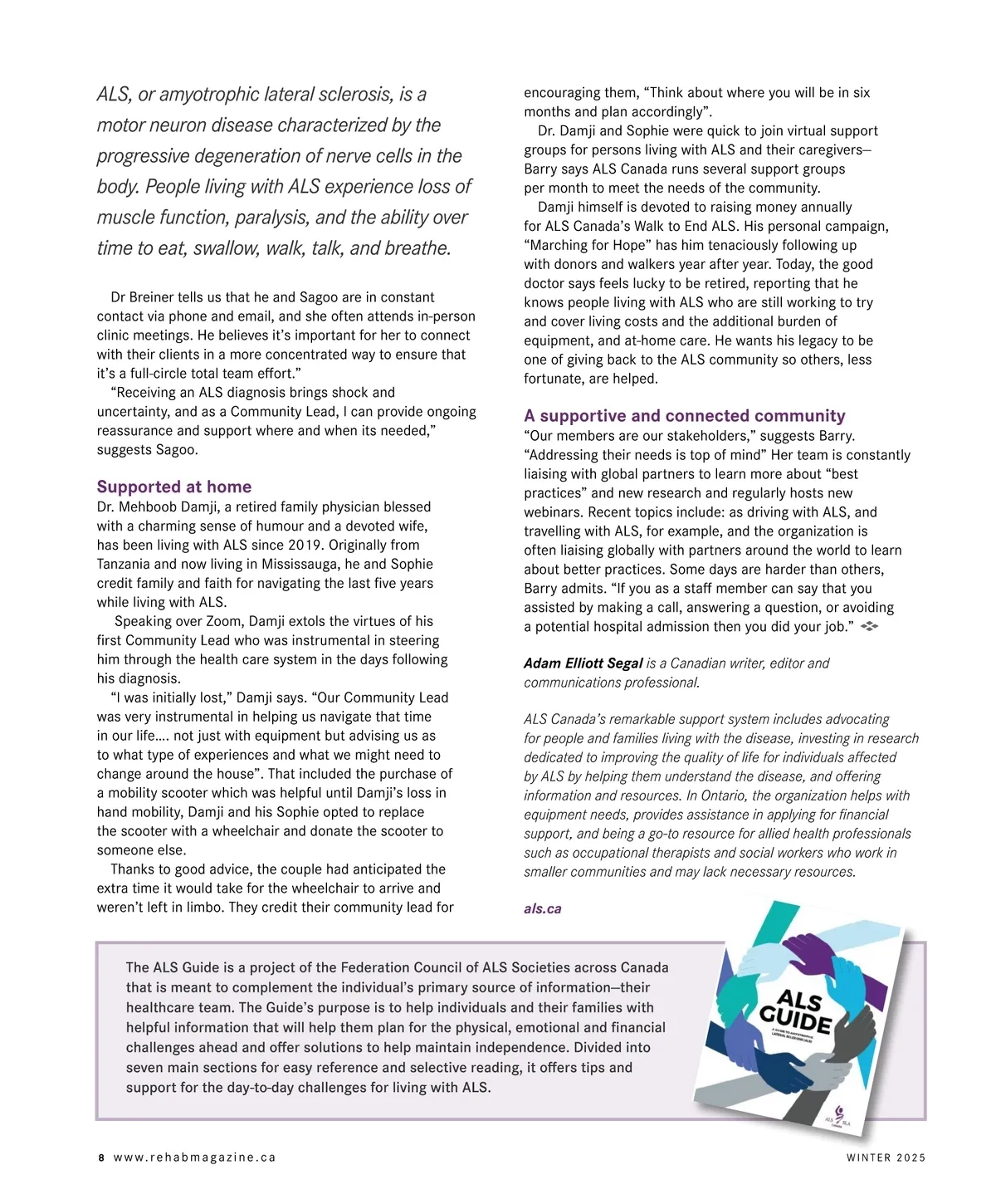
ALS, or amyotrophic lateral sclerosis, is a motor neuron disease characterized by the progressive degeneration of nerve cells in the body. People living with ALS experience loss of muscle function, paralysis, and the ability over time to eat, swallow, walk, talk, and breathe. Dr Breiner tells us that he and Sagoo are in constant contact via phone and email, and she often attends in-person clinic meetings. He believes it’s important for her to connect with their clients in a more concentrated way to ensure that it’s a full-circle total team effort.” “Receiving an ALS diagnosis brings shock and uncertainty, and as a Community Lead, I can provide ongoing reassurance and support where and when its needed,” suggests Sagoo. encouraging them, “Think about where you will be in six months and plan accordingly”. Dr. Damji and Sophie were quick to join virtual support groups for persons living with ALS and their caregivers— Barry says ALS Canada runs several support groups per month to meet the needs of the community. Damji himself is devoted to raising money annually for ALS Canada’s Walk to End ALS. His personal campaign, “Marching for Hope” has him tenaciously following up with donors and walkers year after year. Today, the good doctor says feels lucky to be retired, reporting that he knows people living with ALS who are still working to try and cover living costs and the additional burden of equipment, and at-home care. He wants his legacy to be one of giving back to the ALS community so others, less fortunate, are helped. A supportive and connected community Supported at home Dr. Mehboob Damji, a retired family physician blessed with a charming sense of humour and a devoted wife, has been living with ALS since 2019. Originally from Tanzania and now living in Mississauga, he and Sophie credit family and faith for navigating the last five years while living with ALS. Speaking over Zoom, Damji extols the virtues of his first Community Lead who was instrumental in steering him through the health care system in the days following his diagnosis. “I was initially lost,” Damji says. “Our Community Lead was very instrumental in helping us navigate that time in our life…. not just with equipment but advising us as to what type of experiences and what we might need to change around the house”. That included the purchase of a mobility scooter which was helpful until Damji’s loss in hand mobility, Damji and his Sophie opted to replace the scooter with a wheelchair and donate the scooter to someone else. Thanks to good advice, the couple had anticipated the extra time it would take for the wheelchair to arrive and weren’t left in limbo. They credit their community lead for “Our members are our stakeholders,” suggests Barry. “Addressing their needs is top of mind” Her team is constantly liaising with global partners to learn more about “best practices” and new research and regularly hosts new webinars. Recent topics include: as driving with ALS, and travelling with ALS, for example, and the organization is often liaising globally with partners around the world to learn about better practices. Some days are harder than others, Barry admits. “If you as a staff member can say that you assisted by making a call, answering a question, or avoiding a potential hospital admission then you did your job.” Adam Elliott Segal is a Canadian writer, editor and communications professional. ALS Canada’s remarkable support system includes advocating for people and families living with the disease, investing in research dedicated to improving the quality of life for individuals affected by ALS by helping them understand the disease, and offering information and resources. In Ontario, the organization helps with equipment needs, provides assistance in applying for financial support, and being a go-to resource for allied health professionals such as occupational therapists and social workers who work in smaller communities and may lack necessary resources. als.ca The ALS Guide is a project of the Federation Council of ALS Societies across Canada that is meant to complement the individual’s primary source of information—their healthcare team. The Guide’s purpose is to help individuals and their families with helpful information that will help them plan for the physical, emotional and financial challenges ahead and offer solutions to help maintain independence. Divided into seven main sections for easy reference and selective reading, it offers tips and support for the day-to-day challenges for living with ALS. 8 www.rehabmagazine.ca WINTER 2025
Rehab and Community Care Medicine Winter 2025: Page 8